
When role models are absent, one must learn to become one’s own guide.
The queer women with whom Gender at Work collaborates have taught me a simple truth: when representation is missing, you must learn to become your own guide.
There is no map. No inherited model. No validated path. So, you must define yourself, learn to make choices without permission, and build a life without an instruction manual.
| This is also what the Power Up! programme makes visible. As part of this five-year strategic partnership funded by the Dutch Ministry of Foreign Affairs, Gender at Work supported feminist and rights-based organisations in several regions of the world. Through this programme, partners in Benin, Rwanda, Mozambique, and Tunisia developed spaces where queer women could rebuild themselves, learn, and exercise their power. Between healing, creativity, leadership, and political participation, their initiatives showed that existing in a world that seeks to erase you is already an act of resistance.
The programme was structured around three deeply connected pillars: bodies, voice, and resources. In other words: safety, participation, and the means to live with dignity. |
Being your own guide means accepting that you will walk, get lost, and then find yourself again in a world that refuses to show you the way. It means learning to trust an inner compass, shaped by adversity where family, society, and institutions have failed.
In the stories of several of these women, one image returned insistently: the car. At first glance, the symbol seems ordinary. Yet in the way these stories converge, the car represents much more than a means of transportation. It becomes a symbol of freedom, empowerment, and sometimes even repair.
In many families, there are stages considered “normal” in the building of a life: school, a degree, and then a driver’s licence upon entering adulthood. These parental investments are never neutral. They express projection, recognition, and trust placed in a child and in her future.
They say: your future is worth supporting.
But what happens when that chain breaks?
When parents reject their child because of who she is?
When her sexual orientation or gender identity turn that child into a source of shame, failure, or threat?
Then, very often, everything stops. Investment ceases. And the future closes. One becomes the child in whom nothing more should be invested: the one for whom there is no longer any plan and no possible story. Family exclusion acts here as a form of symbolic dispossession: it strips away the right to the future.
| In Rwanda, this reclaiming took a very concrete form. Thanks to initiatives supported by Power Up!, participants were able to take driving lessons, obtain their licenses, receive legal support in the face of discrimination encountered during the process, and access economic opportunities that had previously been out of reach. Driving thus became the moment when confidence returns, when one once again feels capable of steering one’s own path and taking the wheel of one’s life. |
| Blossom Bridge Initiative (BBI): An organisation working on mental health, economic empowerment, and institutional strengthening. After taking driving lessons, one participant told us: “For a long time, driving felt out of reach, like something that was not meant for me. Thanks to BBI, I was able to sit behind the wheel for the first time in my life. That moment made me realise that, despite stigma and difference, I have the right to steer my own life.”
Ndabaga Sisters’ Organisation (NSO): An organisation working on economic strengthening through entrepreneurship, driving, and mentorship. One NSO member described the experience this way: “For a long time, I felt trapped by other people’s gaze and judgment, by fear, and by everything people said about me. Learning to drive gave me confidence again. Today, I know that I can find work and support myself.” |
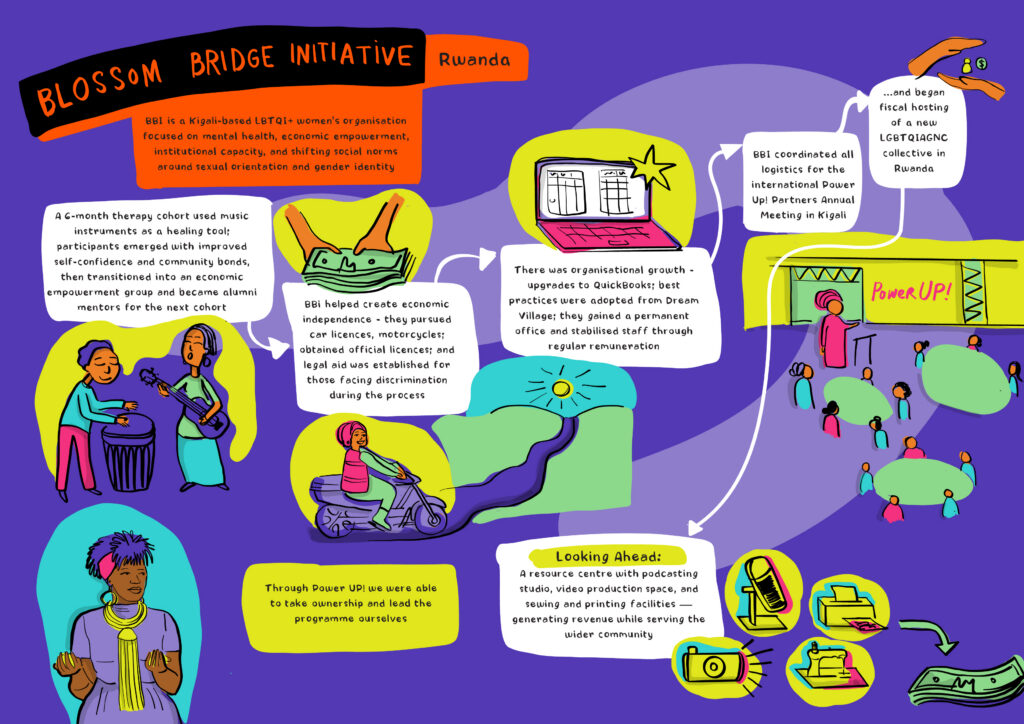
Graphic recording of BBI journey through Power Up!
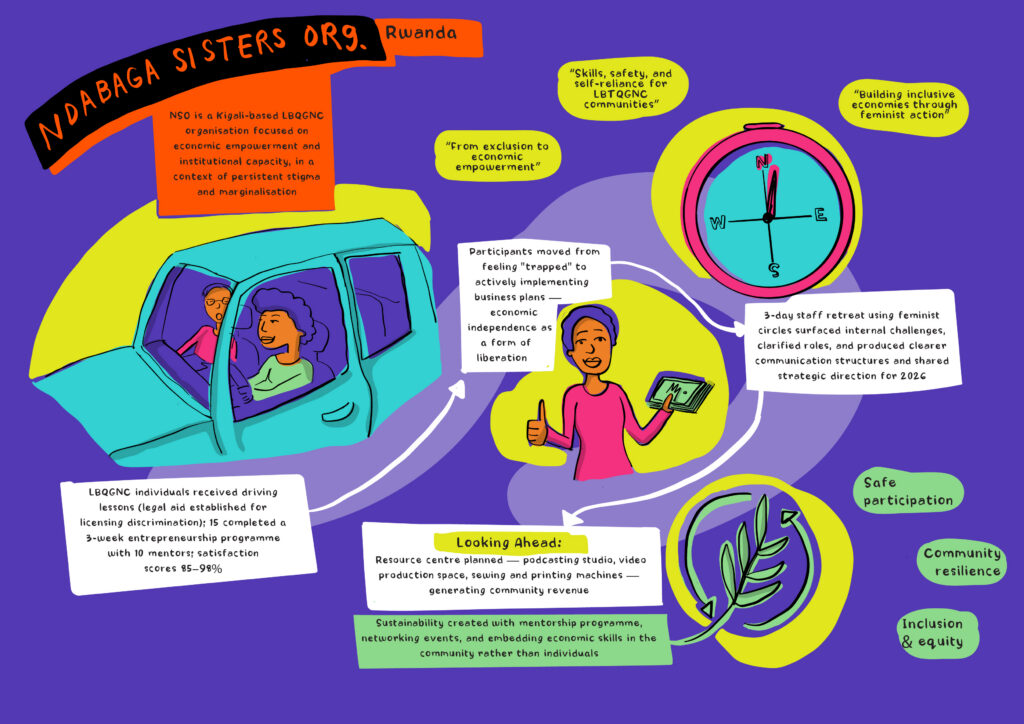
Graphic recording of NSO journey through Power Up! by Nzilani Simu
In this context, learning to drive is no longer just a technical skill. The car ceases to be an object. It becomes an intimate political space, a tool for reclaiming oneself. It embodies freedom of movement, but above all freedom of choice: the possibility of going where you want, when you want, without asking permission and without having to justify yourself.
While some are rebuilding material autonomy, other queer women are confronted with a more existential question: how do you continue living in a world that constantly seeks to erase you?
Erasure takes many forms. It can be legal, through laws that criminalise existence. It can be media-based, through the absence or distortion of narratives. It can be cultural and religious, through discourses that cast you as an anomaly, a threat, or a betrayal.
You are told that you are not legitimate.
Not legitimate as women.
Not legitimate as Africans.
You are made foreign to your own country, to your own culture. Your existence becomes evidence against you. You are no longer a political subject; you become a problem to be solved.
So, in order to keep existing, they choose to create.
To create in order to leave a trace.
To create in order to affirm: we are here.
| In Tunisia, this dynamic took the form of a space for knowledge, creation, and transmission. Through the second edition of Queer University, DAMJ moved the production of queer knowledge beyond the capital city into regions that are often left on the margins. In a context marked by the rise of conservative discourse, security risks, and the shrinking of civic space, creating such a liberatory space was already a strong political act. But one of the most striking facts lies elsewhere: women were the majority there, knowledge was placed at the center, and concrete actions came into being. Creativity was not an add-on; it was a way of refusing erasure. |
| DAMJ: An organisation working in the face of rising conservative discourse and growing security pressure. During the event, one participant said: “Despite the difficult times we are going through, we are trying to remain united and to keep working. Coming together in this space allows us to reflect on collective action. Creating, sharing, and listening to our stories helps us see one another and continue to exist.” |
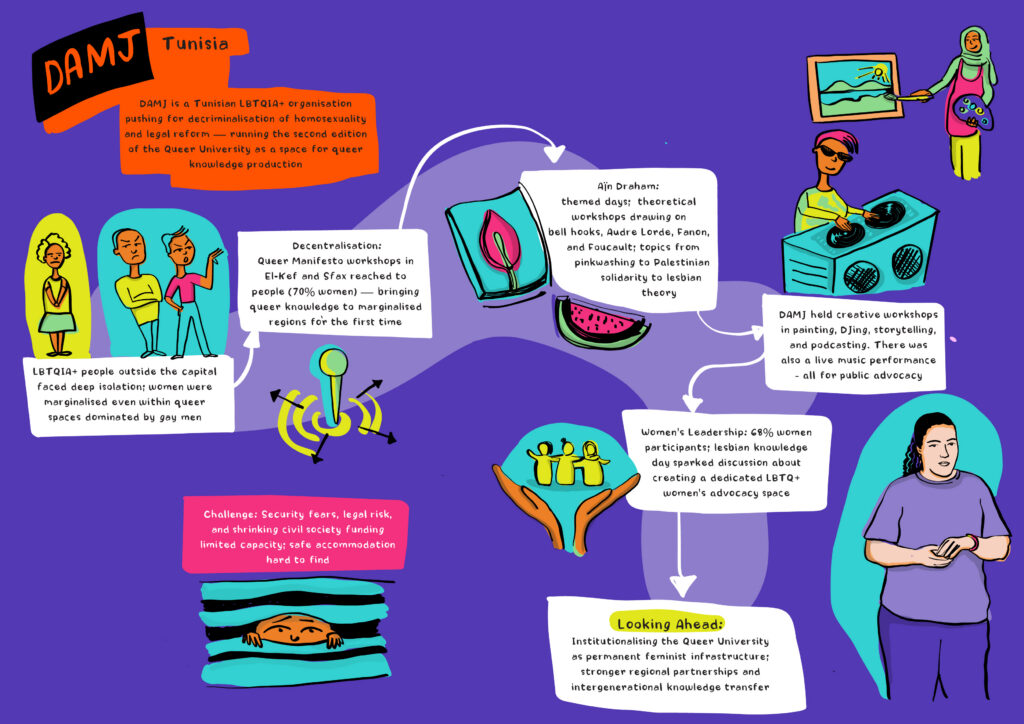
Graphic recording of DAMJ journey through Power Up! by Nzilani Simu
Films, podcasts, paintings, texts, performances… Every act of creativity becomes a living archive. It documents lives that official history refuses to record. It inscribes bodies, voices, and desires into the long term, where society would prefer them to remain fleeting, silent, and invisible.
Other queer women take a different path, but one that is just as deeply political: the path of dialogue, analysis, and understanding structures of power. They create spaces to talk about politics, economics, and governance. They want to understand how their countries function, how decisions are made, and how resources are distributed.
For many of them, politics was long presented as hostile territory: a dangerous, masculinised, inaccessible space reserved for other bodies and other voices. But understanding the mechanisms of power means refusing to be excluded from them. It means recognising oneself as a fully legitimate citizen, directly concerned and entitled to act.
| In Mozambique, this work consisted of linking the lived experiences of queer women to structural analyses of the economy, citizenship, and public participation. In a context where their realities were poorly documented and rarely considered, political empowerment workshops, digital advocacy training, and research made it possible to bring forward data, stories, and demands. It was not only about acquiring skills. It was about shifting the boundaries of what is thinkable: seeing oneself as a political subject, learning how to read power, and knowing you are authorised to intervene in it. |
| POR ELA: An organisation promoting the rights of queer women. After training on digital advocacy, one POR ELA member noted: “We are not only victims. We are also citizens who must take part in the country’s political and economic life. Despite discrimination, we have a place to demand and claim. That is what the trainings showed us.” |
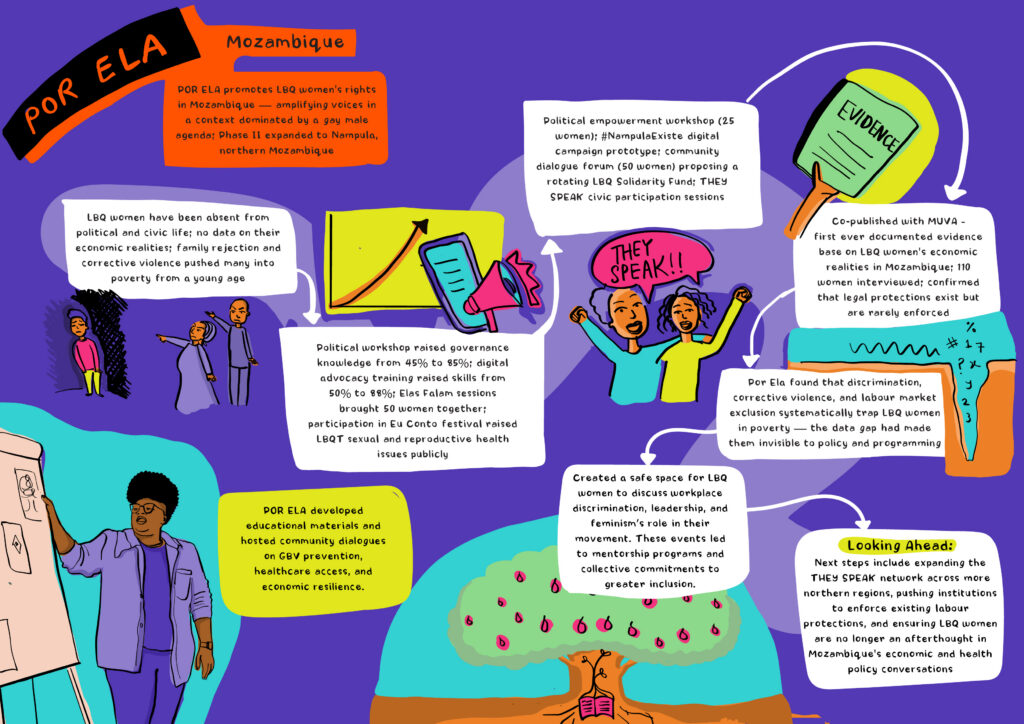
Graphic recording of Por Ela journey through Power Up! by Nzilani Simu
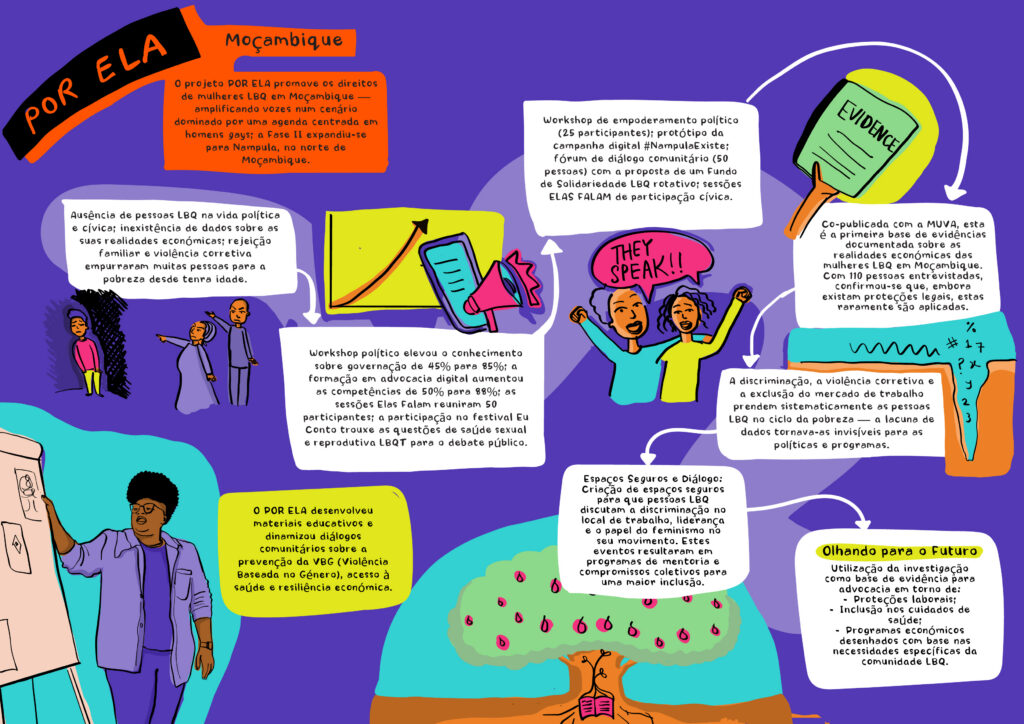
Registo gráfico da jornada de «Por Ela» no «Power Up!», por Nzilani Simu
Some organisations choose to work directly on speech, self-confidence, and leadership. They have observed the effects of imposed silence: queer women present in public spaces, sometimes even invited, yet unable to speak. Paralysed by lack of confidence, by the fear of saying the wrong thing, of saying too much, of being punished.
Learning to speak out thus becomes an act of collective healing. Speaking out is not merely a matter of expressing oneself; it is about reclaiming a confiscated right.
|
In Benin, several initiatives supported by Power Up! worked precisely on this nexus between safety, leadership, advocacy, and care. Workshops on self-defence, bodily autonomy, stress management, transformational leadership, and public speaking helped queer women strengthen not only their capacity to act, but also their ability to stand in public space with greater confidence. What appears clearly in these processes is that voice does not emerge on its own. It needs conditions. It needs safety, psychosocial support, a collective, a place where one gradually learns that one’s voice does not necessarily put one in danger. |
| AFRO-BENIN: A feminist organisation that implemented the project Ma Voix, Mon Pouvoir. One member shared after a public speaking workshop: “I never really knew how to express myself in public, especially since in Benin it is often poorly perceived when a woman speaks out. Thanks to these trainings, I understood that I had the right to express myself, and I learned to share my ideas with greater calm and confidence. It may seem ordinary, but speaking out is essential when it comes to defending one’s rights and advancing advocacy.”
Alliance des Femmes Battantes (AFB): A feminist organisation active in five cities and working on organisational development, mental health, and advocacy. One participant spoke about the workshops on non-violent responses: “Enduring insults and stigma every day is a heavy burden to carry. Thanks to the training on non-violent responses, I learned that it was possible to defend myself without putting myself in greater danger. Today, I feel stronger, more confident, and above all better prepared to face what comes.” |
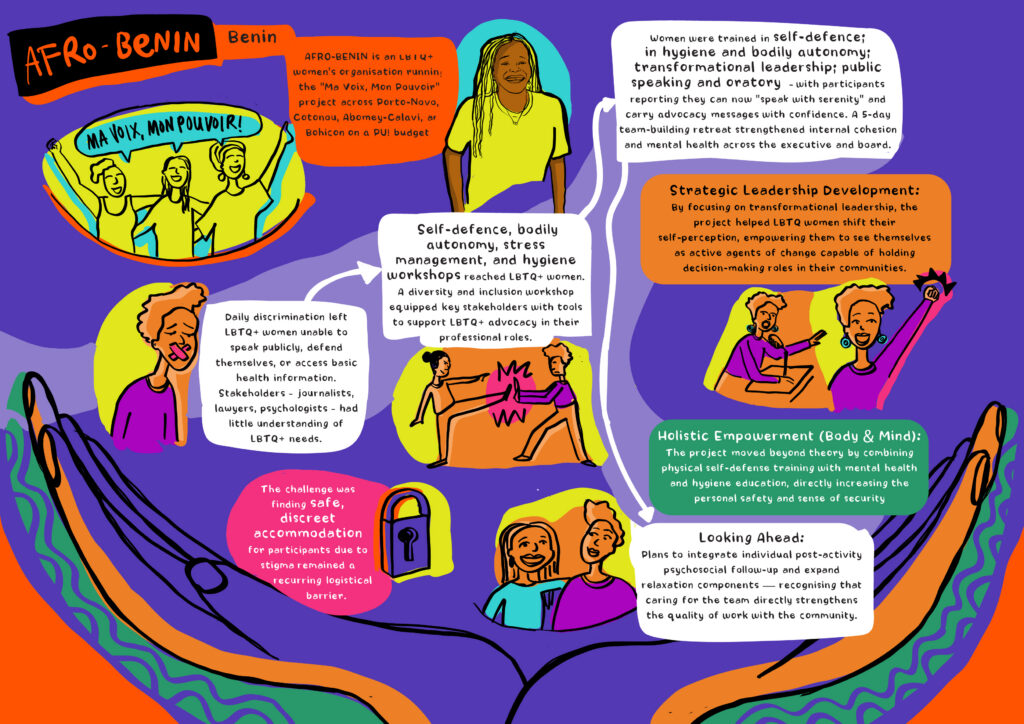
Graphic recording of Afro-Benin journey through Power Up! by Nzilani Simu
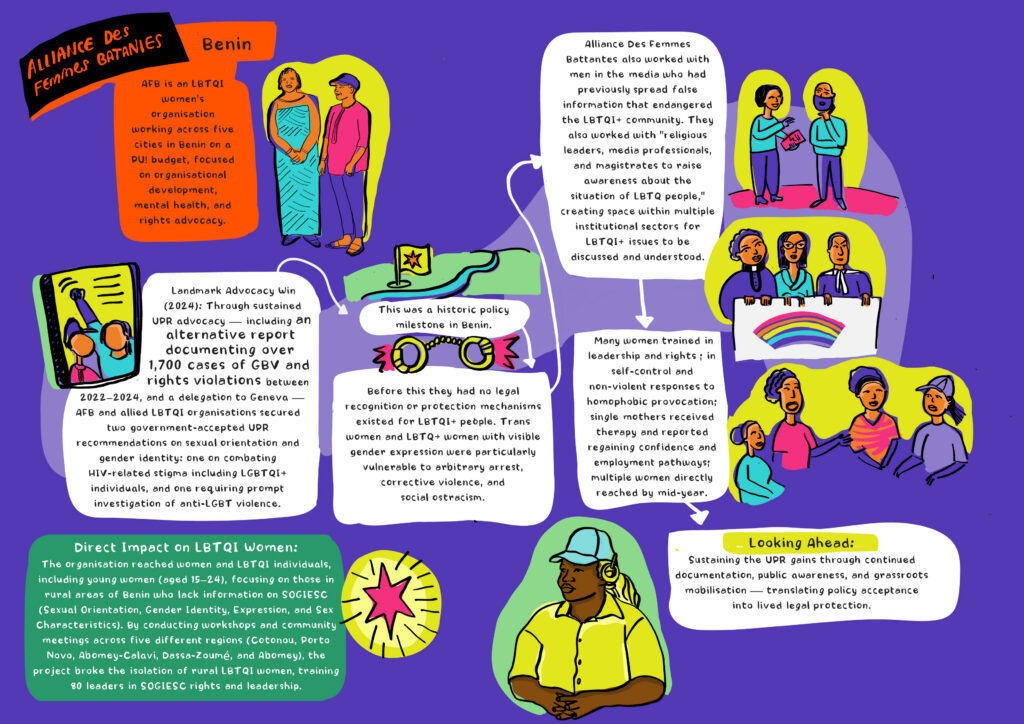
Graphic recording of AFB journey through Power Up! by Nzilani Simu
At the heart of all these strategies of renewal, there is also care.
Care for oneself, care for others, care for the invisible wounds left by years of rejection.
Music therapy, art, wellness spaces, team retreats, talking circles, moments for collective breathing: none of this is incidental.
In the journeys of these partner organisations, care does not appear as an extra added onto activism. It is an enabling condition for activism. It makes it possible to reconnect with the body, emotions, and the desire to live. It also makes it possible to endure over time, not reducing queer women to their capacity for resistance alone, but recognising their right to joy, safety, slowness, and imagination.
Creating one’s own world is not an escape from reality. It is a refusal to be crushed. It is a gesture of radical love that consists of imagining possible futures when everything has been organised to prevent those futures from existing.
Living as a queer woman means tracing paths where none existed before. It means building new structures when the old ones exclude. It means learning, everyday, to invent one’s freedom, to choose one’s life, and to guide oneself.
And in this act of creation, one truth remains:
they are here,
they have always been here, and they will continue to exist.
Learn more about Power Up!