
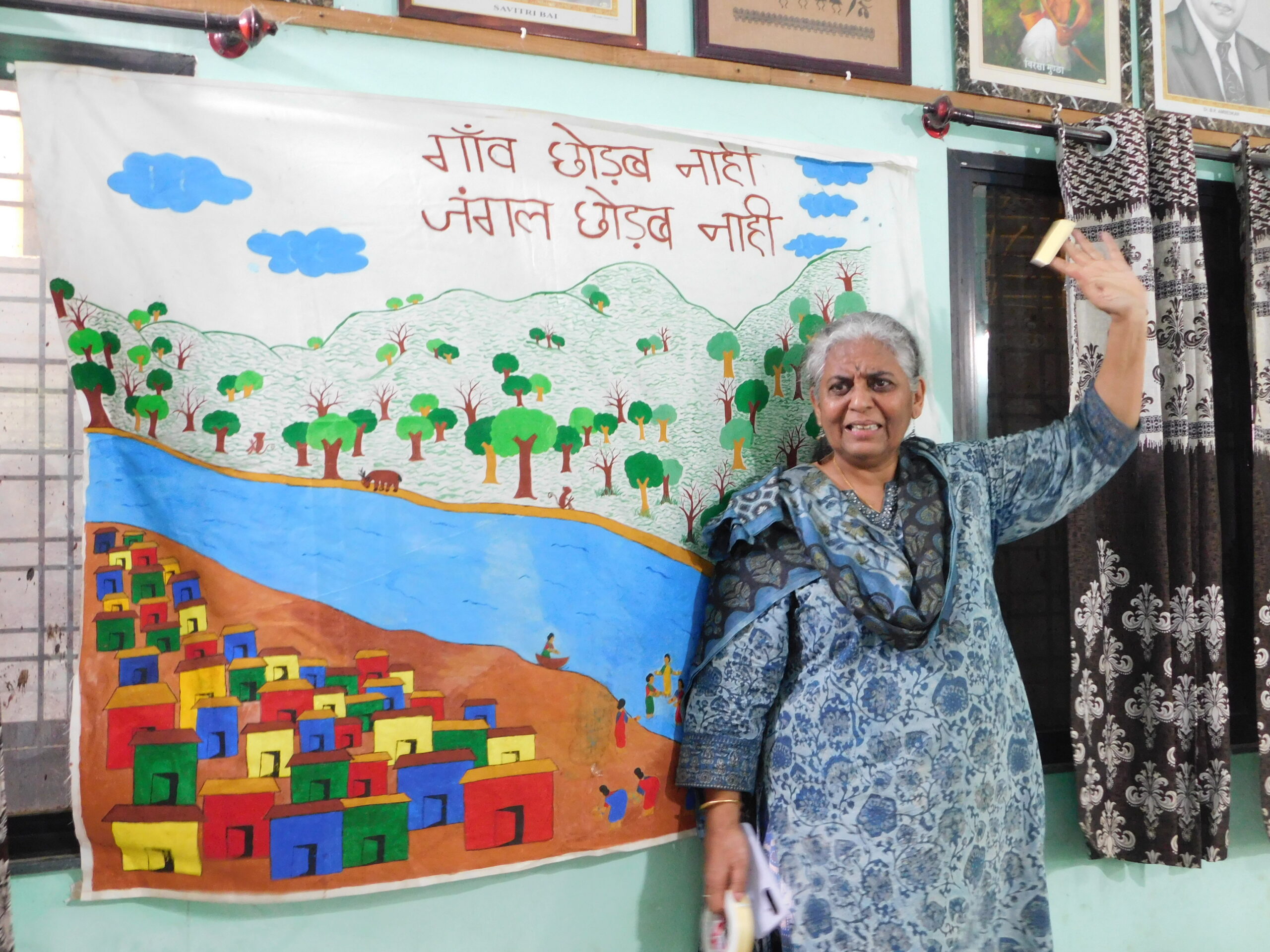
Soma standing in front of a banner created by the Chhattisgarh team on Jal Jungle Jameen- the poster reads- Gaon Chorab Naahi, Jungle chorab Naahi (Won’t leave the Village, won’t leave the Forest)
A Room Full of Stories
We were all transfixed. We were physically tired, but we were absolutely present because her story was simultaneously terrifying and incredibly inspiring.
Just before Anju* (name changed), CK had finished. I caught only fragments of her story, something about a painful, unacknowledged struggle for respect within her own home. She confessed to feeling like a whole person only when she came to work. Here, she was valued, depended upon, her instincts trusted. She presented a capable, seasoned exterior, yet the deep pain beneath it was private, tender, and quietly fresh.
This was the quiet ritual of our evenings: women sharing the precise dimensions of their struggles, the personal cost of every accomplishment. The personal was indeed political because every breath, every whispered hope, every resource secured or denied, was tied to the larger, uncompromising world.
What Was Power Up! in India?
The meeting was a review of the five-year journey of the Power Up! project for the Indian partners. Power Up! was a multi-country initiative designed to strengthen women’s leadership and shift power in institutions and communities. In India, partners shaped it into the Netri Program.
It was held in Kurkheda, one of the project sites where Aami Amcha ArogyaSathi (AAAs) has its office. The location was chosen specifically because Padma would not be able to travel with her months-old baby. It truly takes a village to raise a child, and in this instance, it took Netris traveling from across the country to Kurkheda to ensure Padma, the project’s enduring anchor, was a vital part of the review.
The partners in India call their Power Up! initiative the Netri Program. The entire Netri Program is a masterclass in strengthening women’s leadership and policy participation. The core objective is to build women’s leadership so they can articulate the assertion of their rights. Power Up! provided an opportunity to examine Forest Rights through a gender lens, evaluating their impact on women’s access to and control over their bodies, their voices in decision-making, and their resources.
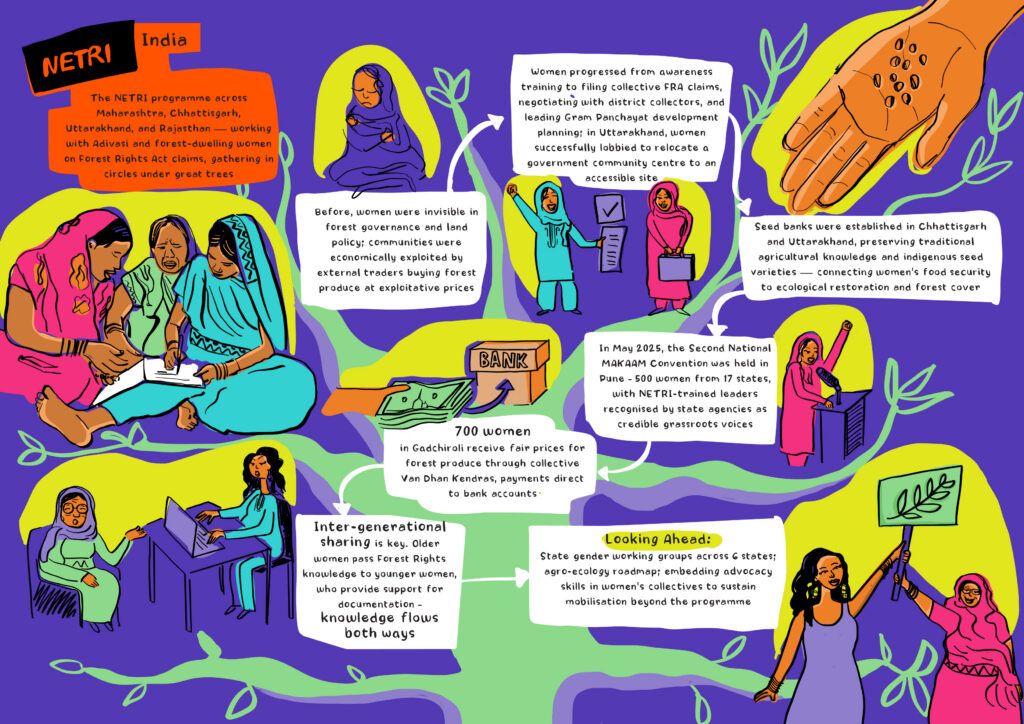
Graphic recording of Netri journey through Power Up! by Nzilani Simu
This work is also shaped by a partnership that evolved over time between Gender at Work and the India partners, grounded in trust, dialogue, and shared feminist intent. What began as a structured funding relationship gradually shifted into one of co-learning and solidarity, where Gender at Work engaged as a learning partner rather than a distant donor. Through ongoing exchange, field visits, and relationship-building with leaders like Padma and Soma, the partnership deepened into one that centred mutual understanding, enabling the work to grow with both clarity and care.
The Political Tax of Presence
The journey of the Netri, the female leader, does not begin on a platform or in a protest line. It begins in the deep, pre-dawn silence of the home. Soma, the feminist anchor of the project, welcomed everyone and asked, “What time did you wake up to prepare for this journey?”
The answers were a collective, unspoken memoir of taiyaari, the invisible labour that is a woman’s political tax, the cost of her presence. Women woke at 2 AM, 3 AM, 4 AM, and 5 AM to cook for their families, cut fodder for animals, arrange childcare, and prepare their households for their absence. Some husbands were supportive. Most women narrated hours spent pre-compensating for the absence of their labour for the next 3–4 days.
Building Leadership Through Bodies, Voice and Resources
Netri was meticulously planned using the bodies, voices and resources framework. It would be a phased process: Inclusion, Representation, Active Participation, Leadership. It required sustained effort, a careful, continuous holding of the space, to draw women together for discussions and to forge that vital collective identity.
Over time, they built capacity, holding workshops on topics ranging from alternative economies to the brutality of gender-based violence, and mostly on Forest Rights. They prepared the women for public participation, rehearsing mock sessions of the Gram Sabha so their voices would not falter when the moment arrived.
The Gram Sabha is the village assembly, made up of all adult members, and is recognised under laws like the PESA Act and the Forest Rights Act (FRA), 2006 as the key decision-making body at the local level. The FRA acknowledges the rights of forest-dwelling communities to land and resources, placing the Gram Sabha at the centre of governance. Yet, despite these provisions, women are often excluded in practice. The Netri Program works to change this by preparing women to participate confidently in these spaces, enabling them to claim their role as rights-holders, decision-makers, and leaders.
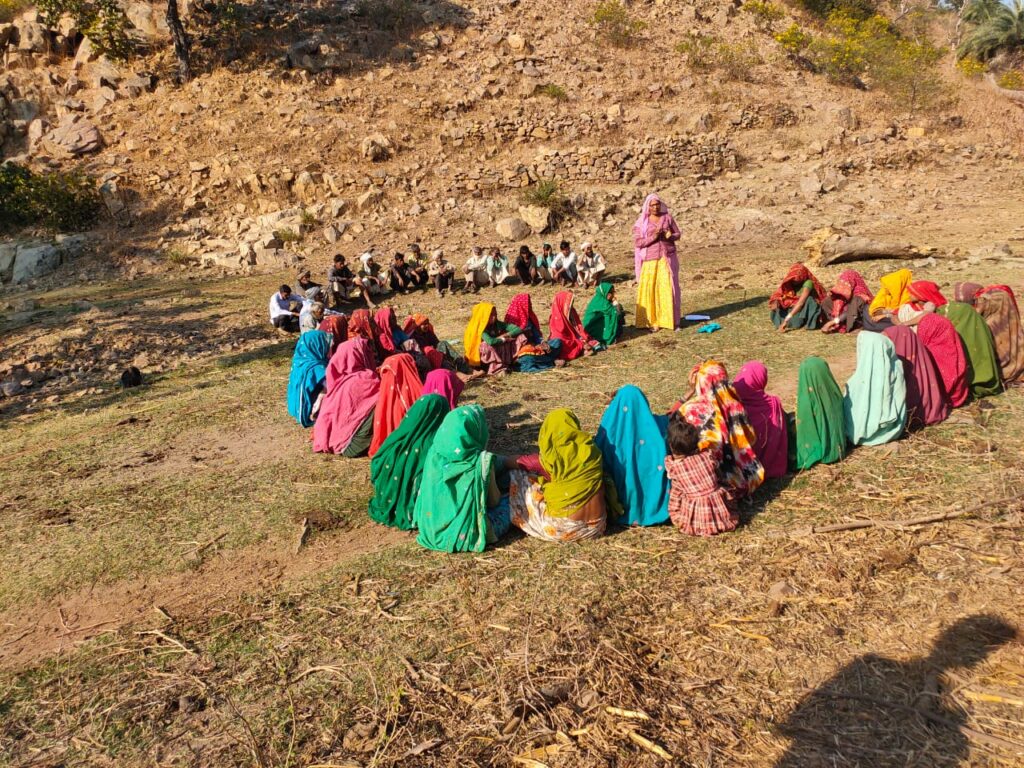
Netri meeting in Rajasthan
Economic Transformation and Dignity
The tangible rewards of this strengthened leadership were astonishing. Within the Gram Sabhas, the Netris achieved an economic transformation. Their collective income from forest produce skyrocketed from ₹5,000 to ₹81,000 over the last few years, a seismic shift that completely eliminated the necessity of unsafe migration. Women now controlled the income and entered the marketplace. The victory over the Tendu Patta buyers was not just an increase in revenue; it was the assertion of economic dignity.
The Netri story is one of dual action: Sangharsh (Struggle/Resistance) against injustice and Nirmaan (Rebuilding/Construction) of new systems. This dual power is vividly expressed in the work of the collectives.
Standing at the Frontline of Resistance
In Chhattisgarh, the Netris focused on a right-based movement. They expanded from 20 to 50 villages. The number of local management committees grew from 4 to 25, and core Netris from 100 to 200. The number of panchayats went up from 13 to 45, women collectives from 68 to 170.
This is the same Anju we began this story with. Years ago, when there was a major land-grab attempt at their village, Anju along with others from the sangathan stood at the forefront of that attack. It led to Anju losing her home, and everything else because they were burnt to the ground to scare them. Having lost everything, Anju was not deterred and continued to stand up against them using all the knowledge from the meetings to challenge them and push them back. The village had won.
The driving force behind the Chhattisgarh chapter is Rajim, a fierce, lifelong leader with a history of struggle for the rights of marginalized communities. Rajim sees organizing as the singular key strategy to bring about change, firmly stating that “Sangathans sustain, NGOs might not.”
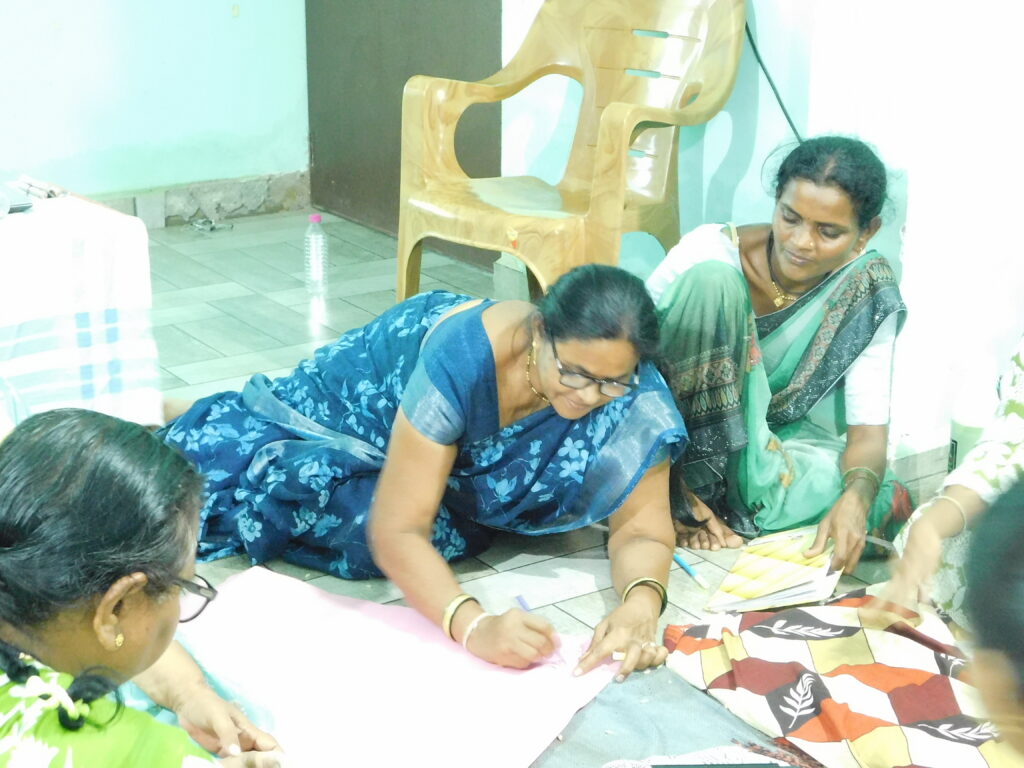
Netris planning and strategizing for the next 5 years in mixed state group
Securing Land, Securing Power
The Chhattisgarh Netris successfully secured Individual Forest Rights (IFR) for 17,000 people and strategically linked their members to schemes like MGNREGA and the Mahila Kisan Credit Card. Securing land rights documentation in the names of women was a transformative act, providing a tangible source of power by acknowledging women’s legal identity, property, and ownership. This provided a steady source of income, which led to a significant reduction in unsafe migration.
In Uttarakhand, the Netris addressed the core issue of survival and documentation. Through camps and persistent efforts, the collectives helped families claim Individual Forest Rights and secure housing under schemes like Atal Awas Yojna and PM Awas Yojna (government housing schemes). When marginalized women secure documents and land rights, they are not just gaining Resources, they are gaining a political Voice to protect their Bodies and their very existence.
The Power of the Sangathan
In Maharashtra, the structural centre of the Netri program resides in Aami Amcha ArogyaSathi (AAAs), based in Kurkheda, Gadchiroli. Since 1984, the organization’s work shifted to the essential task of organizing the Sangathans. They recognized that the collective was the one true unit that could not only initiate change, but sustain it once its roots had deepened.
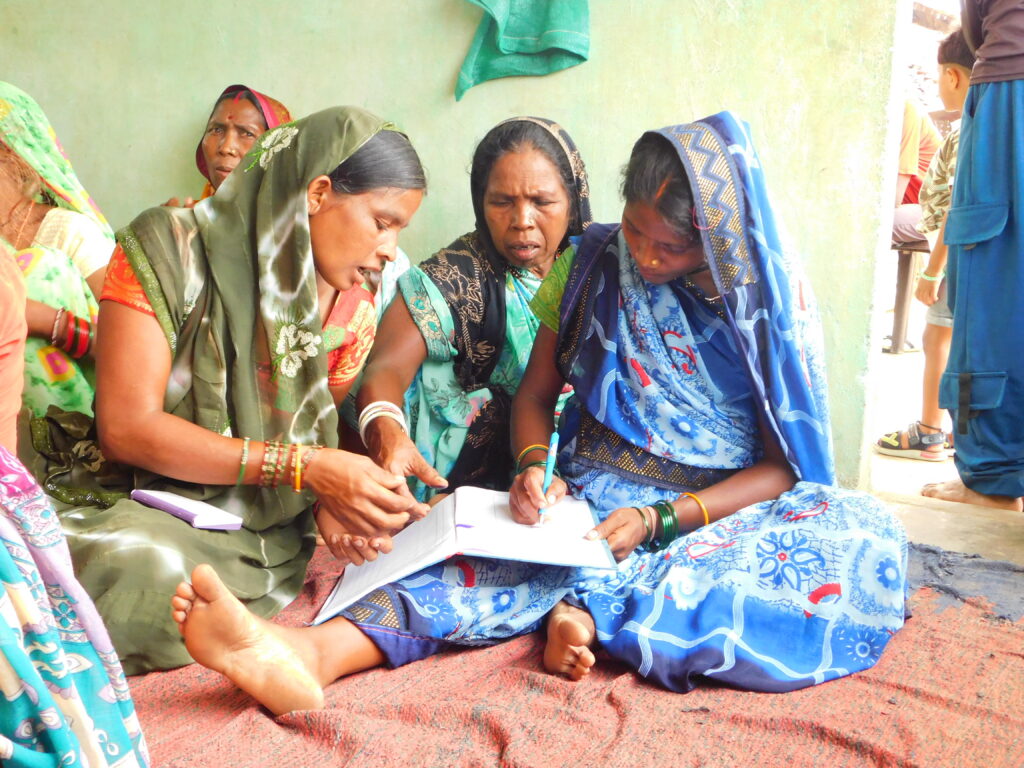
Netris in Maharashtra attending a village meeting and marking their attendance for it
Women’s collectives are essential for disrupting entrenched patriarchal norms, which rely on the premise that women’s primary roles are to listen and follow. By creating an internal structure defined by equality, transparency, and shared work, the Sangathan profoundly increases members’ confidence, their participation in decision-making, and their ability to articulate their own needs.
The true definition of the Sangathan lies not just in its structure, but in its internal practice of radical love and equality. The Collective is not merely a political entity; it is a place of care. It is where women find both energy and friendship, standing together through joys and sorrows. This foundational connection sustains their engagement through long struggles and allows their external political manifestation to be unexpectedly strong.
From Project to Movement
Alliance-building proved to be a major strategy. Their collaboration with the MAKAAM network influenced groups in Gujarat, Tamil Nadu, and Jharkhand to either consider a state chapter or adopt a feminist lens in their existing Forest Rights work. Their mobilization relies on rallies, posters, slogans, songs, banners, theatre, and pamphlets. This visibility ensures their demands are amplified and engaging to the wider community and policymakers. The Netri state chapter heads have been strategically collaborating with National Coalition for Natural Farming (a multi-stakeholder platform, including NGOs, researchers, and government bodies, aimed at scaling up natural farming across India) and Revitalising Rainfed Agriculture Network (a collective of civil society organizations and practitioners focused specifically on rainfed areas-which make up about 60% of India’s cultivated land) to integrate forest-based livelihoods and a gender lens into the national agroecology programme. It focused on developing a gender-transformative roadmap through stakeholder consultations, ensuring that lead partner organizations internalize these equity-driven agendas.
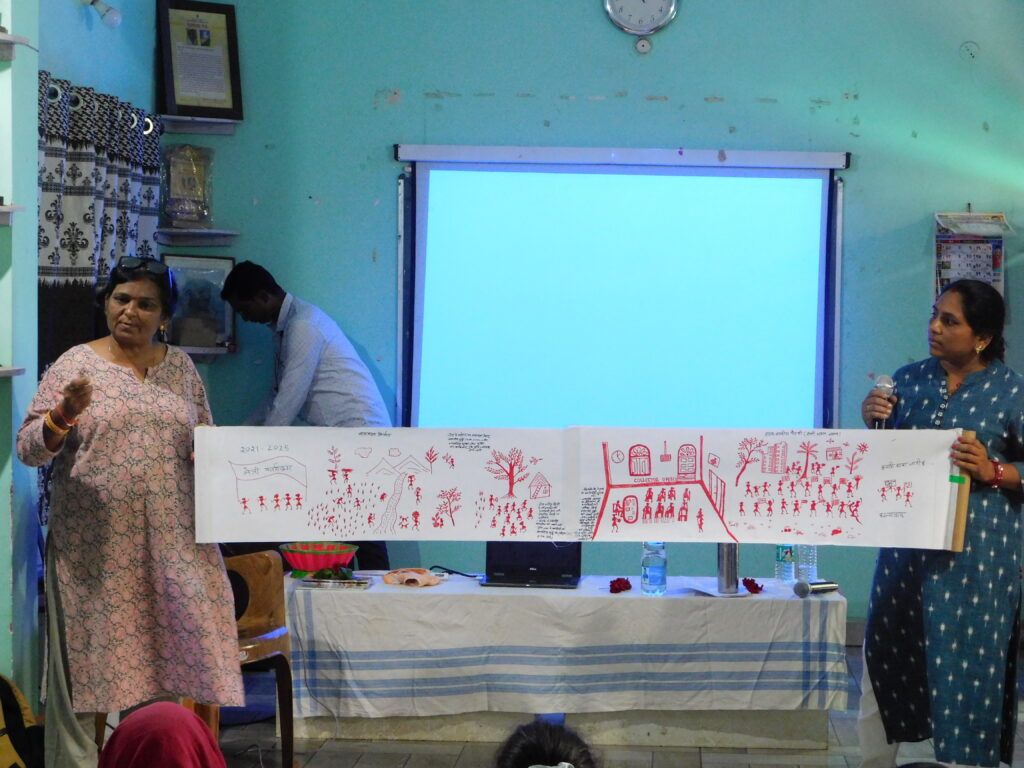
Rajasthan Netris depicting their 5 year journey on a picture scroll
Each state group had a list of plans for the next 5 years. They did not treat it as a concluding meeting even though the project cycle is coming to an end. Despite facing a critical constraint in funding, the Netris have a clear, defiant plan: to move from 4 to 8 states and build a National Collective. They were not dejected. I guess that’s the difference between movements and projects.
The Forest Rights Act (FRA), which acknowledges the historic injustices and accepts that people are the natural custodians of the forests, is not just a law. It is the legal scaffolding for a women-led movement that is defining its own path to autonomy, dignity, and a sustainable future.
The Netri Program is therefore a dynamic movement built on radical love, strategic alliances, and the unyielding collective power of women who have walked from their kitchens into the rooms of power.
Read the full report
Learn more about Power Up!