Balancing on the Cusp
G@W Senior Associate Michal Friedman reflects on the benefits of peer learning, action learning, emergent learning approach for organisations
At Gender at Work, we are committed to reflection as both a political and pedagogical act, using it to reveal insights, challenge assumptions, and adapt our practices. Our approach to learning is emergent: shaped by context, grounded in feminist values and open to the unknown. We see learning as both a method and a muscle: something strengthened through practice, vulnerability and shared reflection.
G@W Senior Associate Michal Friedman reflects on the benefits of peer learning, action learning, emergent learning approach for organisations
G@W Senior Associate David Kelleher reflects on his work with IDRC to advance gender equality in development research.
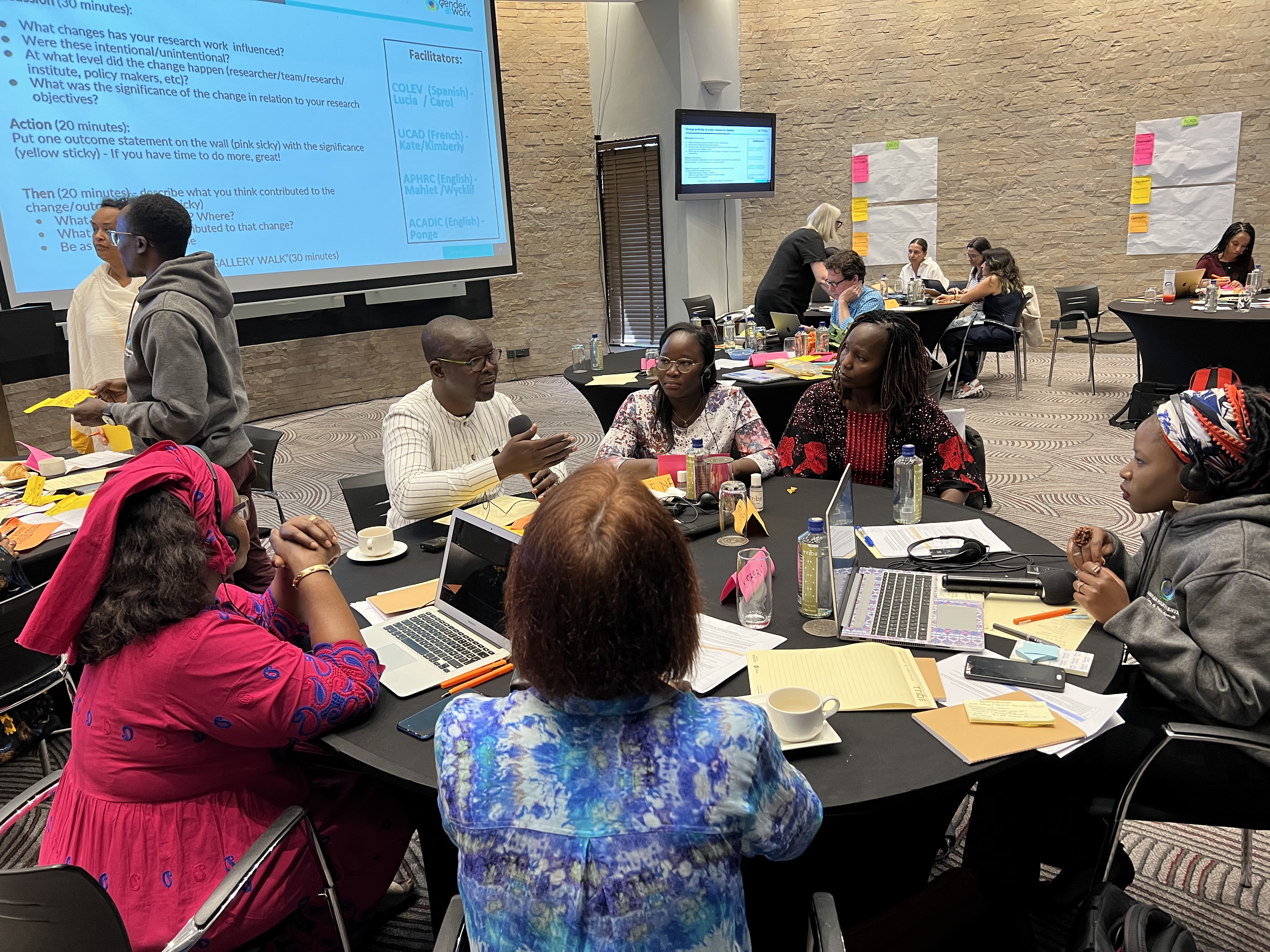
In this final blogpost of the AI Research and COVID: Journeys to Gender Equality and Inclusion series, Carol Miller and Marie-Katherine (Kate) Waller reflect on the key threads of this blog series that emerged from Gender at Work and research grantees’ collaboration in an 18-month gender action learning process in the AI4COVID program. They also highlight how researcher journeys, and the GAL process demonstrated the importance of creating safe spaces for learning and the value of multidisciplinary collaboration in supporting social transformation.
G@W Senior Associate David Kelleher reflects on his changing understanding of having and being a mentor.
In the tenth blogpost of the AI Research and COVID: Journeys to Gender Equality and Inclusion series, Sandra Patricia Martínez-Cabezas reflects on her research in the COLEV project, which focused on using responsible AI and data science to address COVID-19 challenges in Colombia.
Dans le neuvième blog de la série Recherche sur l’IA et COVID : voyages vers l’égalité des genres et l’inclusion), Hélène Diéne partage son expérience de la pandémie, où elle travaillait dans une clinique COVID-19 comme assistante de recherche et tombe elle-même malade par la suite.
In the ninth blogpost of the AI Research and COVID: Journeys to Gender Equality and Inclusion series, Hélène Agnès Diéne shares her experiences during the pandemic, working in a COVID-19 clinic and later falling ill herself.
G@W Associate Nina Benjamin reflects on her role in the facilitation team for the project with the Human Sciences Research Council (HSRC) to support science granting councils (SGCs) across the African continent to advance gender transformation in relation to science, technology and innovation (STI).
G@W Associate Khanysa E. Mabyeka reflects on her role in the facilitation team for the project with the Human Sciences Research Council (HSRC) to support science granting councils (SGCs) across the African continent to advance gender transformation in relation to science, technology and innovation (STI).
In early 2020, Gender at Work (G@W) was invited by the Human Sciences Research Council (HSRC), to partner in a project to support science granting councils (SGCs) across the African continent, to advance gender transformation in relation to science, technology and innovation (STI).
Dans le huitième blog de la série Recherche sur l’IA et COVID : voyages vers l’égalité des genres et l’inclusion), Tidiane Ndoye explique comment ses expériences ont nourri sa passion pour les questions de genre dans le domaine de la santé et son rôle en tant qu’expert principal en matière de genre dans le projet de recherche AI4COVID, Utilisation de l’intelligence artificielle pour lutter contre le COVID-19 au Sénégal et au Mali.
In the the eighth blog post of the AI Research and COVID: Journeys to Gender Equality and Inclusion series, Tidiane Ndoye shares how his experiences nurtured his passion for gender issues in health, and his role as a lead gender expert in the AI4COVID research project, Using artificial intelligence to combat COVID-19 in Senegal and Mali.